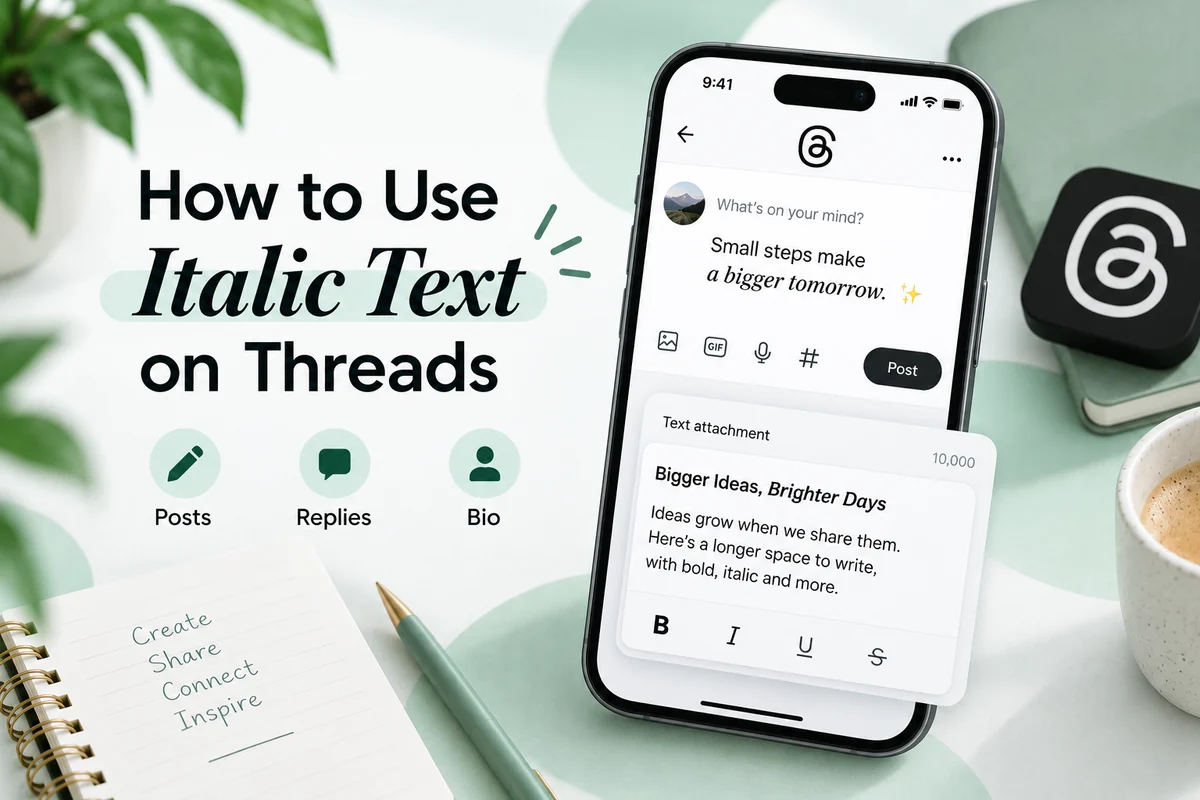
X has never had inline formatting. Posts, replies and quote posts are plain text, and every styled post you have scrolled past was made by substituting characters. Italic text on X means pasting Unicode characters that are already slanted, not applying a style to letters.
That makes the platform unusually predictable. If a character exists on the reader’s device, it renders. The complications are all downstream: search, links, character counting and screen readers.
What survives
Converted text posts cleanly into the composer, the reply box, quote posts and your display name. It survives an edit. It shows up in the API payload exactly as you typed it, because to X it is ordinary text with no special handling.
It also survives being copied out. Someone quoting your post into a message or a document carries the styling with them, because the shape lives in the characters rather than in any markup.
Where each field stands
| Field | Native formatting | Unicode | Recommended |
|---|---|---|---|
| Post | No | Yes | One short phrase |
| Reply | No | Yes | Sparingly |
| Quote post commentary | No | Yes | Sparingly |
| Display name | No | Yes | Safest place on the platform |
| @ handle | No | No | Not possible |
| Bio | No | Yes | Keep searchable words plain |
| Location field | No | Yes | Keep plain, it is scanned |
| Alt text | No | Yes | Never, it exists to be read |
| URL | No | No | Never, it breaks the link |
| Hashtag | No | Technically | Do not, keep plain |
The handle is restricted to letters, digits and underscores, so converted characters are rejected rather than merely unwise. The display name directly above it is a separate field with no such restriction.
Display names are the sweet spot
Your display name is read by people and carries very little search weight. It is also the most visible line attached to everything you post, appearing in timelines, notifications and quote posts.
That combination makes it the best place on X for a converted flourish. One or two styled words work; a fully styled name starts to read as spam and becomes awkward for anyone trying to refer to you in text.
Keep in mind that the name renders at notification size more often than at profile size. Cursive script that looks elegant on a profile page can be illegible in a notification list, so plain Italic or Sans Serif Italic survive better.
What quietly breaks
Three failures happen often enough to plan around, and all three are silent. Nothing warns you.
Search. X search matches literal characters. A post whose keywords are converted will not be returned by a search for those words, and it will not appear in a saved search or a keyword based list. If a post is meant to be found later, the searchable terms have to be ordinary letters.
Links. Styled characters inside a URL break it entirely. The address no longer matches, so nothing resolves and no link preview generates. Never style a domain, a path or a shortened link.
Alt text. Image descriptions exist to be read aloud. Styling them removes the only description a blind user has, which is the opposite of what the field is for.
Hashtags belong on the same list. A converted hashtag is a separate tag from the plain one, joining a feed with almost nothing in it.
Character count is not always what you expect
Every converted character normally counts as one character against the post limit in the official composer. The wrinkle is that mathematical alphanumeric characters live outside the Basic Multilingual Plane, which means they take two UTF-16 code units rather than one.
Most clients handle this correctly. Some third party clients and scheduling tools count the code units instead, so a post that fits in the official composer is rejected by a scheduler. If you are writing to the edge of the limit, test in the tool you actually publish with rather than assuming.
Underline and strikethrough behave differently
These two are not substituted letters at all. They are combining marks stacked onto ordinary characters: U+0332 draws a line under the character before it, U+0336 draws one through it.
Because the underlying letters are unchanged, an underlined word on X is still the word. Search can match it, a reader can copy it, and a screen reader that ignores the marks announces the plain word correctly. That makes them the least disruptive styles on the platform and the only ones that keep your words findable while still looking different.
The cost is length. Each character becomes two code points, so an underlined phrase spends twice its apparent budget against the post limit. On a platform with a hard limit that matters. The mechanism is covered in full in how underline and strikethrough actually work.
Threads of posts, quote posts and replies
A single styled post is one decision. A thread is a different problem, because the cost compounds.
In a thread, every post is read in sequence by someone who has already committed. Converted characters slow each one slightly, and by the fifth post that friction is doing real damage to the thing threads are good at, which is holding attention through a long argument.
The practical convention that has emerged is to style the first post only, if at all, and keep the body of the thread plain. If a phrase recurs across the thread as a motif, styling that one phrase each time it appears reads as deliberate structure rather than decoration.
Quote posts add a wrinkle. Your commentary is a separate field from the quoted post, and it appears above it in a smaller visual block. Converted characters there sit directly next to the quoted author’s plain text, which makes the contrast sharper than it would be in a standalone post. That can work in your favour, or it can look like you are shouting over someone.
Replies are the place to be most conservative. A reply is read in a narrow column at small size, often in a long chain, and it is the surface where people are most likely to be scanning rather than reading. Converted characters in a reply are also harder to quote back accurately by anyone typing rather than copying, which matters in a medium built on quoting.
Accessibility on a text first platform
X is almost entirely text, which raises the stakes. Converted characters are separate Unicode characters rather than styled letters, and depending on the reader and its verbosity setting they can be announced one at a time using full character names, read as unrecognised symbols, or skipped.
A single converted phrase in a plain post is a small cost. A converted display name is larger, because it is announced every time you appear in someone’s timeline or notifications. A thread written entirely in converted characters is unusable for that listener.
What screen readers really announce covers the readers individually. The short version for X: style the name of a thing, not the information about it.
Bios and the location field
The bio is where most people put their converted phrase, and it is a reasonable choice with one caveat.
X profile search matches bio text, so anything describing what you do belongs in ordinary letters. The pattern that works is the same one that works everywhere: a plain sentence saying who you are, then a styled line carrying tone.
The location field is the one people forget. It is free text rather than a picker, and it is scanned by people deciding whether you are local to them and by third party tools building lists. A converted city name is invisible to both, and it gains almost nothing visually because the field renders in small grey type.
The website field is a URL and follows the same rule as links anywhere else: never style it, because a converted character means the address does not resolve.
Try it on one post
- Write a post where the last line is a sign off rather than information.
- Convert only that line and paste it back in.
- Post it, then search X for a word from the styled line.
- Search for a word from the plain part of the same post.
- Check how the post renders in a browser and in the mobile app.
Steps three and four run the experiment against a single post, which makes the result impossible to argue with: the plain half is findable, the styled half is not.
Troubleshooting
The handle field rejected it. Expected. Handles accept letters, digits and underscores only.
A link stopped working after styling. The address no longer matches. Retype the URL in ordinary characters.
A scheduler said the post was too long. That client is counting UTF-16 code units. Shorten the post or publish from the official composer.
Digits stayed upright inside an italic phrase. Unicode’s italic range has no digits at all. Bold and monospace do include them.
Underline lost its line when pasted. Some paste paths drop trailing combining marks. Paste into a note first, then copy from there.
One letter in an italic word looks wrong. Almost always the letter h, which Unicode borrows from a different block. Covered in why some italic letters are missing.
Questions people ask about styled text on X
How do you write italic text on X? Convert the phrase in a generator and paste it. There is no formatting in the composer and never has been.
Does search find styled posts? No. Search is literal, so converted keywords are invisible to it.
Can you style a handle? No. Handles are restricted to letters, digits and underscores. The display name is a separate field that accepts converted characters.
Do styled characters count as one character? Usually in the official composer. Some third party clients count them as two, so test if you are near the limit.
Why does styling a link break it? Because a URL must match the real address exactly, and a converted letter is a different character.
Where that leaves you
X is the most predictable platform for converted text and one of the least forgiving about where you put it. The display name is the right place. Post keywords, links, hashtags, the handle and alt text are the wrong ones, and underline and strikethrough are the two styles that let you have the visual difference without giving up findability.
If you also post to a feed that recently gained real formatting, the Threads guide covers a platform where the answer is now split between two composers.